




Service features Feature
The concept of enterprise performance management (EPM)
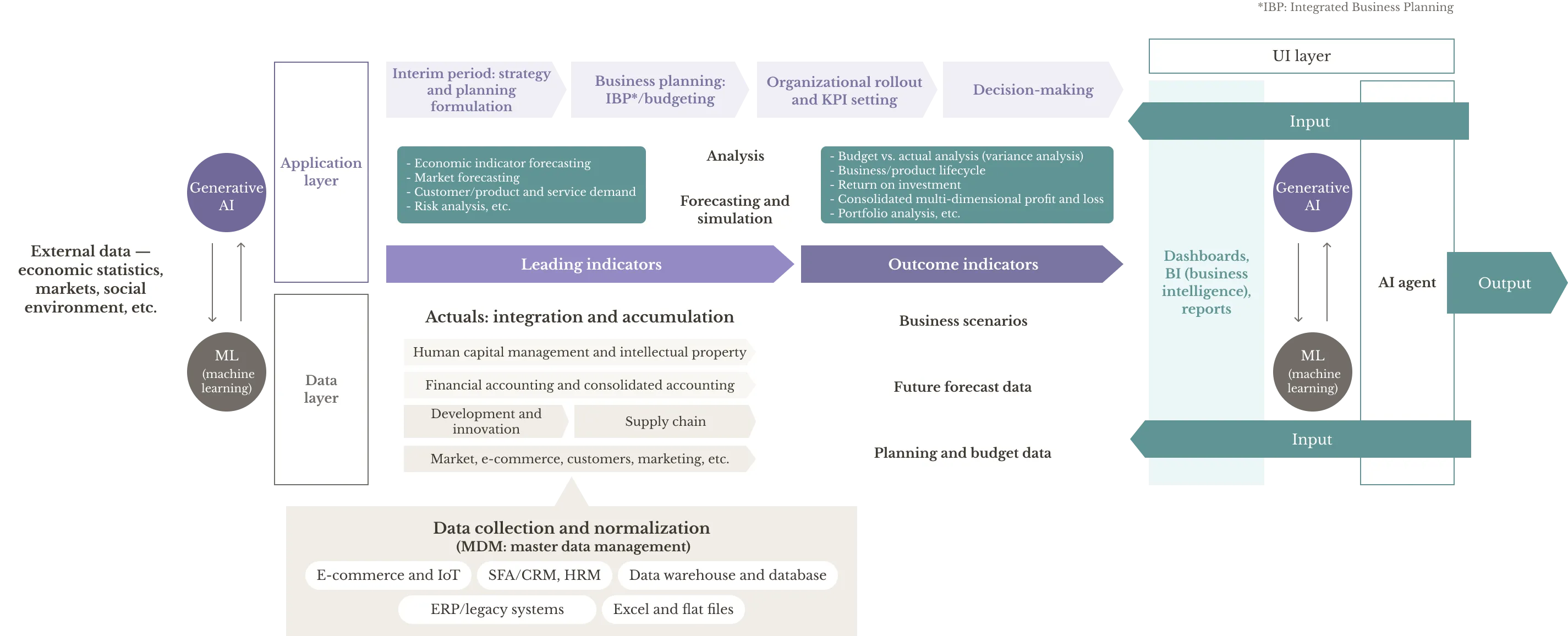
EPM is a concept that encompasses the entire process of “performance management” and broadly consists of the following three functions and processes:
0 1
Integrated business planning and budgeting processes for corporate groups

This involves formulating strategic plans and, based on them, developing business plans and budgets for each business domain and group company.
0 2
Functions for collecting, integrating, and accumulating various financial and non-financial actual data

This involves collecting, integrating, and accumulating big data from core systems such as ERP, production/sales/logistics, accounting, and HR, as well as customer‑ and sales‑based systems such as customer relationship management (CRM) and sales force automation (SFA).
It also encompasses macroeconomic and market information for future forecasting, along with non‑financial information required for ESG-oriented management, including human capital management. For global enterprises, consolidated accounting and foreign currency translation functions are also needed.
0 3
Financial planning & analysis (FP&A) process supporting decision-making on resource allocation

ROE/This involves calculating various KPIs required for ROE/ROIC-focused management and business portfolio analysis, performing data comparisons and time‑series analyses such as budget vs. actuals and budget vs. forecasts, and conducting ROI analysis, forecasting, and simulations. The process provides business units and top management with the data to support business decision‑making.
An EPM tool is designed to systematize these three functions and processes.
Illustrative overview of EPM
The following three points are cited as reasons why EPM tools are gaining attention:
- The speed of change in the social and economic environment and markets has accelerated, and the volume of information that must be considered in management decision-making, such as ESG and other non-financial information, has increased.
- It is becoming impractical to handle the above using Excel due to the increase in data volume, demands for operational speed, and the handling of time-series data.
- Due to technological progress, multiple vendors have released excellent tools that support the EPM domain, and the number of companies achieving actual implementation benefits is increasing globally. Another influential factor is the fact that the latest EPM tools are provided as cloud‑based services (SaaS), which significantly lowers the hurdles to initial implementation.
Scope of Services Our Service
Our EPM implementation services
We have entered into implementation consulting partner agreements for Board and CCH Tagetik, both of which are highly evaluated globally and are being adopted by many companies. Leveraging our expertise in management control and management accounting, we support EPM tool implementation, primarily in the FP&A (financial planning and analysis) domain, ranging from individual entities to the entire consolidated group, in collaboration with IT companies well-versed in EPM tool development.
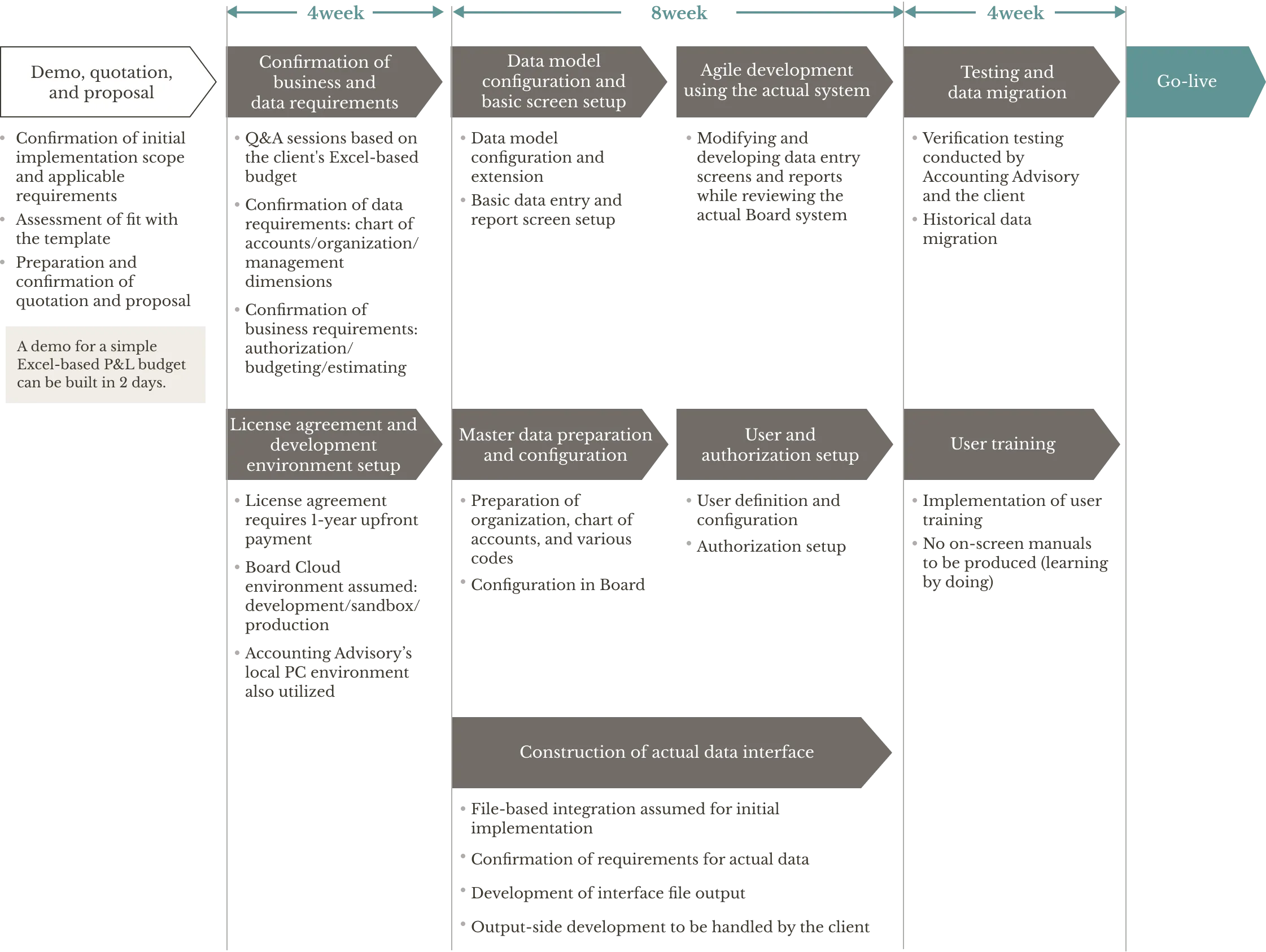
Specifically for Board implementation, we first interview the client company about their requests at the initial proposal stage. We then define an initial scope of approximately four to six months for the design, development, and implementation phases. During that period, we proceed with development using an agile approach. Our methodology is to establish what may be called a series of “small waterfalls.” After completing the implementation of the initial scope, we establish the next waterfall and continue with agile development and implementation within it. This approach allows us to achieve effects in a relatively short period while expanding the scope of application.
Furthermore, the basic data model does not change significantly for general business companies in terms of budget, actuals, and estimate management centered on financial accounting. Therefore, for Board, we have developed a functioning “Budget Management Template,” which, when applied, makes it possible to implement the tool in a shorter period.

Below is the model for our short‑term implementation approach based on the Budget Management Template. Standard implementation takes four months, and for simple configurations, implementation can be completed in in three months at the shortest.
Service
- IFRS / U.S. GAAP / New Accounting Standards
- Financial Closing Support (Japan / Overseas)
- IPO (Japan / Overseas)
- Fraud Response and Prior Period Restatements
- Management Accounting
-
- Enterprise performance management (EPM) tool implementation support
- Solutions for integrating statutory and management accounting
 Enterprise performance management (EPM) tool implementation support
- Financial Advisory