

Index

Overview Overview
Financial Closing Acceleration Support
Rapid and continuous changes in the society and economic environment has a significant impact on the finance and accounting teams. While management is facing an array of challenges to overcome low capital efficiency (ROE, ROIC, etc.) and profitability, such as ESG and human capital management and management conscious of cost of capital, finance and accounting teams are required to serve as a business partner who supports business growth by using diverse data sets.
The evolving landscape of institutional accounting also requires addressing multifaced issues, such as increasing complexity of accounting standards due to convergence with IFRS Accounting Standards, increasingly complex disclosure documents, and stricter audit requirements.
However, a lack of skilled professionals remains a major bottleneck for many companies. As scaling up the workforce through hiring is often not a realistic solution, we need to accelerate the monthly financial closing process to “create the time” to cope with this issue.
Accelerating the monthly financial closing to promptly provide financial figures allows executives to gain a timely understanding of business conditions and make management decisions more quickly. This is crucial for enhancing corporate competitiveness.

Traditional financial closing acceleration approach
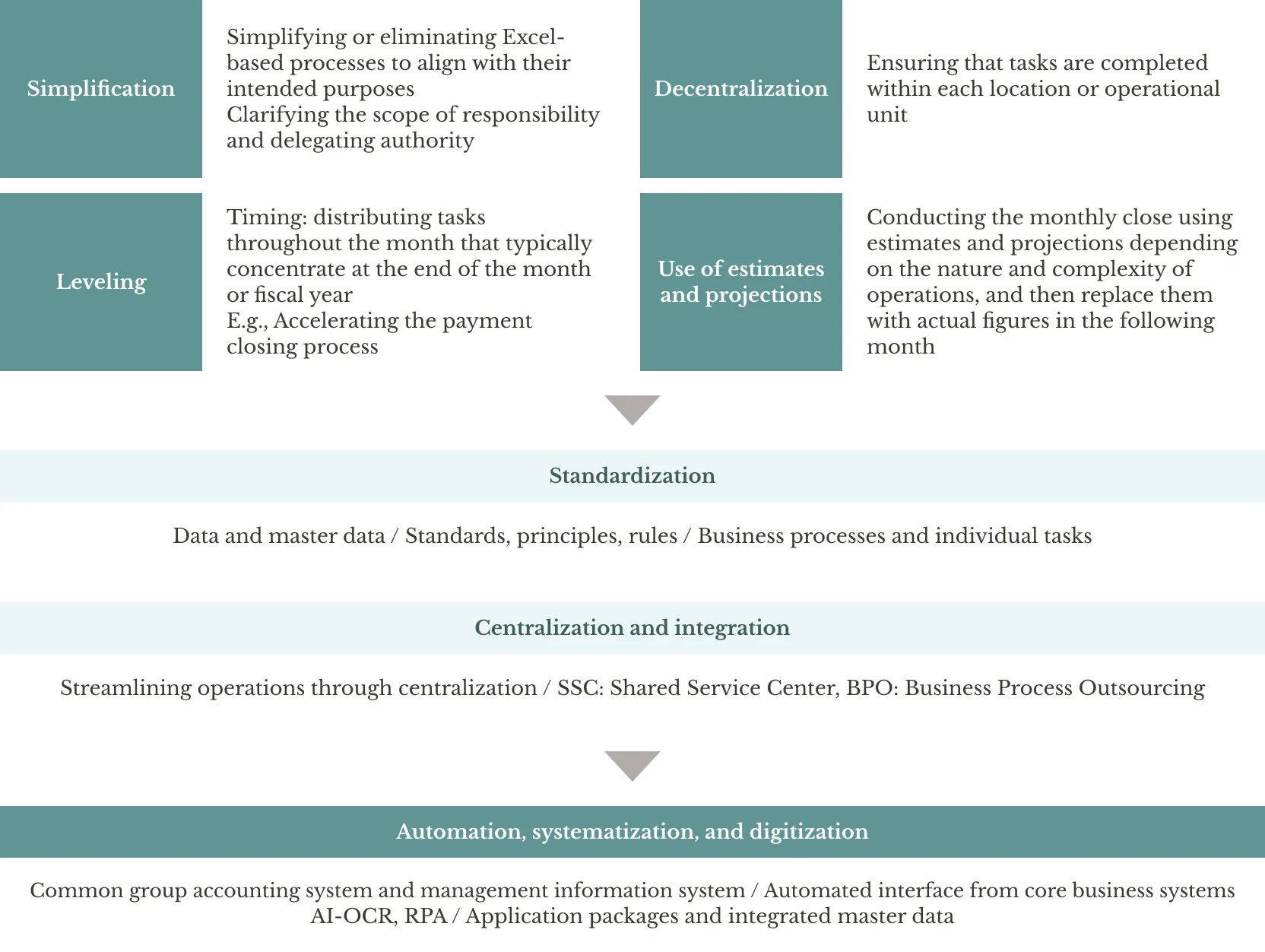
Financial closing acceleration has been a long-standing challenge and its methodology is well-established. The traditional approach to accelerating and streamlining financial closing is outlined below. In particular, simplification, decentralization, leveling, use of estimates and projections, and standardization are effective principles for streamlining operations within finance and accounting teams and accelerating the financial closing process.
DX: modern financial closing acceleration
Today, the best practice of monthly financial closing process for global companies takes approximately three days for both stand-alone and consolidated financial reporting. To achieve this level, it is essential to re-engineer business processes, systems, and data flows across the entire group under the concept of “driving digitization/digitalization and automation,” rather than taking debottlenecking approach.
Business process re-engineering
- B2B transactions: promote the adoption of commercial EDI,
- B2C transactions: accelerate the adoption of e-payment systems,
- Paper-based data entry: Streamline operations through RPA,
Class 1 RPA = Excel slips + RPA
Class 2 RPA = AI/OCR + RPA - Zengin EDI System (ZEDI),
- Electronically Recorded Monetary Claims (ERMCs),
- Global Cash Management (GCMS), etc.
Digitization/digitalization of internal documents and business processes
- Digitization of documents under the e-Document Law
- Application of the Electronic Books Maintenance Act
Invoices and other evidenced documents,
Digitization of receipts by taking photos with a smartphone,
Accounting books and slips,
Rules/terms, etc. - Paper-based data entry: Streamline operations through RPA,
Class 1 RPA = Excel slips + RPA
Class 2 RPA = AI/OCR + RPA - Workflow systems
- Collaboration tools
Data standardization, integration, and connectivity
- Integrated information infrastructure
Integrated information data base / data lake
Integrable journal entry interface tool - Open API
- Master data management (MDM)
- Development and implementation of a data standardization concept
Simplification of business processes
- Discontinuation of non-value-added operations
- Analytics (statistics and probability analysis)
Elimination of accounting approvals
Detection of irregular transactions - Leveling of business operations
Deferring of non-material tasks to the post-monthly closing period (following month)
Business process automation and standardization
- Automation and standardization of business processes to fit to standard automated features of packaged systems
Scope of Services Our Service
Services for financial closing acceleration projects
Our support focuses on achieving practical implementation and ensuring operational embedding within finance and accounting teams. Our experienced CPAs will provide support services for monthly financial closing, disclosure and audit-related tasks, and re-engineering of the management accounting and business intelligence processes to help our clients achieve effective improvements.
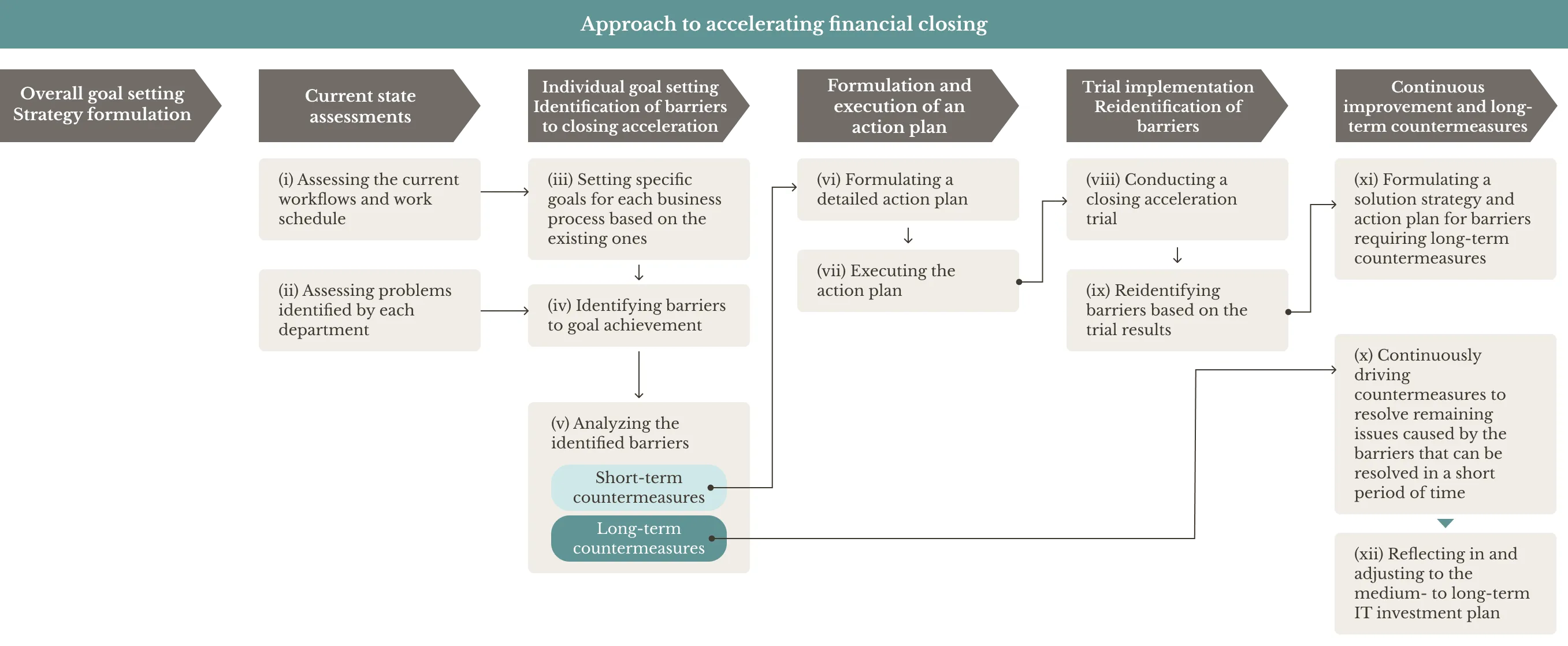
Specific approach is as described below:
-
0 1
Overall goal setting and strategy formulation
Define the scope of organizations and business processes covered by the project and formulate goals and re-engineering strategy, and then seek validation by management.
-
0 2
Current state assessments
Shift the focus of the assessments from the cause of delay in the financial closing process to the way to solve the delay and gathering schedule and other information necessary to set goals for individual business processes.
-
0 3
Individual goal setting and identification of barriers
Identify business processes and individual business functions that hinder the acceleration of financial closing, clarify the underlying factors, and sort them into short-term and long-term countermeasures. Set target dates for individual business functions within the monthly financial closing process.
-
0 4
Formulation and execution of an action plan
Formulate an action plan that specifies how to re-engineer and improve the identified business processes and individual business functions through short-term countermeasures. Implement the plan after thorough consultation with the company to verify its practical feasibility and ensure that it can be seamlessly integrated into actual operations.
-
0 5
Trial implementation and reidentification of barriers
Conduct the monthly closing process based on the action plan to verify whether necessary tasks can be completed by the target dates, and reidentify remaining issues and their underlying barriers.
-
0 6
Continuous improvement and long-term countermeasures
Re-engineer the business processes and refine the countermeasures for issues and barriers identified through the trial, and make continuous improvements in the monthly financial closing process to ensure the realization of financial closing acceleration. When necessary, develop human resources, review and redefine the division of roles, and restructure the financial closing system.
Implement long-term countermeasures that involve significant organizational changes, such as the introduction of a shared service center (SSC) and business process outsourcing (BPO), after consulting with relevant departments about the strategic direction of such countermeasures and preparing action plans.
Service
- IFRS / U.S. GAAP / New Accounting Standards
- Financial Closing Support (Japan / Overseas)
-
- Accounting and financial closing support
- Overseas subsidiary management support
- Financial closing acceleration support
 Financial closing acceleration support
- IPO (Japan / Overseas)
- Fraud Response and Prior Period Restatements
- Management Accounting
- Financial Advisory